







Windsor-Essex County (WEC) is home to an increasingly diverse population, enriched by residents who speak a wide range of languages and bring with them unique cultural backgrounds. While English and French remain the two official languages of the region, a significant proportion of individuals and families report using non-official languages in their daily lives. This diversity shapes the way community members access health information, programs, and services, underscoring the importance of clear and inclusive communication delivered by public health.
As a trusted health partner in the region, the Windsor-Essex County Health Unit (WECHU) is committed to ensuring that all clients can receive information, guidance, and care in a manner that is both accessible and culturally responsive. Providing robust language support is an essential part of this commitment. Through a range of services – such as interpretation, translation, and designated bilingual positions – the WECHU works to eliminate language-related barriers and promote equitable access to public health resources for all residents.
This report outlines the variety of language supports currently in place at the health unit, highlighting how these tools and services strengthen client interactions and uphold WECHU’s dedication to delivering inclusive and client‑centered care across Windsor-Essex County.
Phone Services
For staff who work directly with clients – either in-person or over the phone – interpreter services are available through the RIO Network by Access Alliance. This is an on-demand service staff can access via phone or video call to assist in communicating with clients.
Staff call into the service and are connected with an interpreter in the desired language. Departments have their own access code for tracking and billing purposes, which also provides additional information when determining language needs per department.
To assist clients when they call into the health unit, the interactive voice response (IVR) system was translated into French in 2025, allowing callers to choose between the English or French menu to locate the department or service they’re seeking. This step was important in meeting requirements through the French Language Services Act.
Usage
Over a six-month timeframe in 2025, the top languages accessed by the WECHU staff through the RIO Network service were Spanish, Arabic, Somali, Dari, and Mandarin. This accounts for interpretation services utilized across all departments.
| Language | Number of Calls | Total Minutes |
|---|---|---|
| Spanish | 239 | 3,788 |
| Arabic | 314 | 3,755 |
| Somali | 117 | 1,917 |
| Dari | 85 | 1,228 |
| Mandarin | 75 | 935 |
Website Translation
The EverWay tool performs a variety of functions on the websites owned and operated by the WECHU including wechu.org, wecoss.ca, and our survey platform. By clicking the ear icon on a webpage, visitors have accessibility supports such as a screen reader, screen mask (text highlighting), font resizing, downloadable audio of a page, and language translation. The tool can translate content into over 100 languages.
Usage
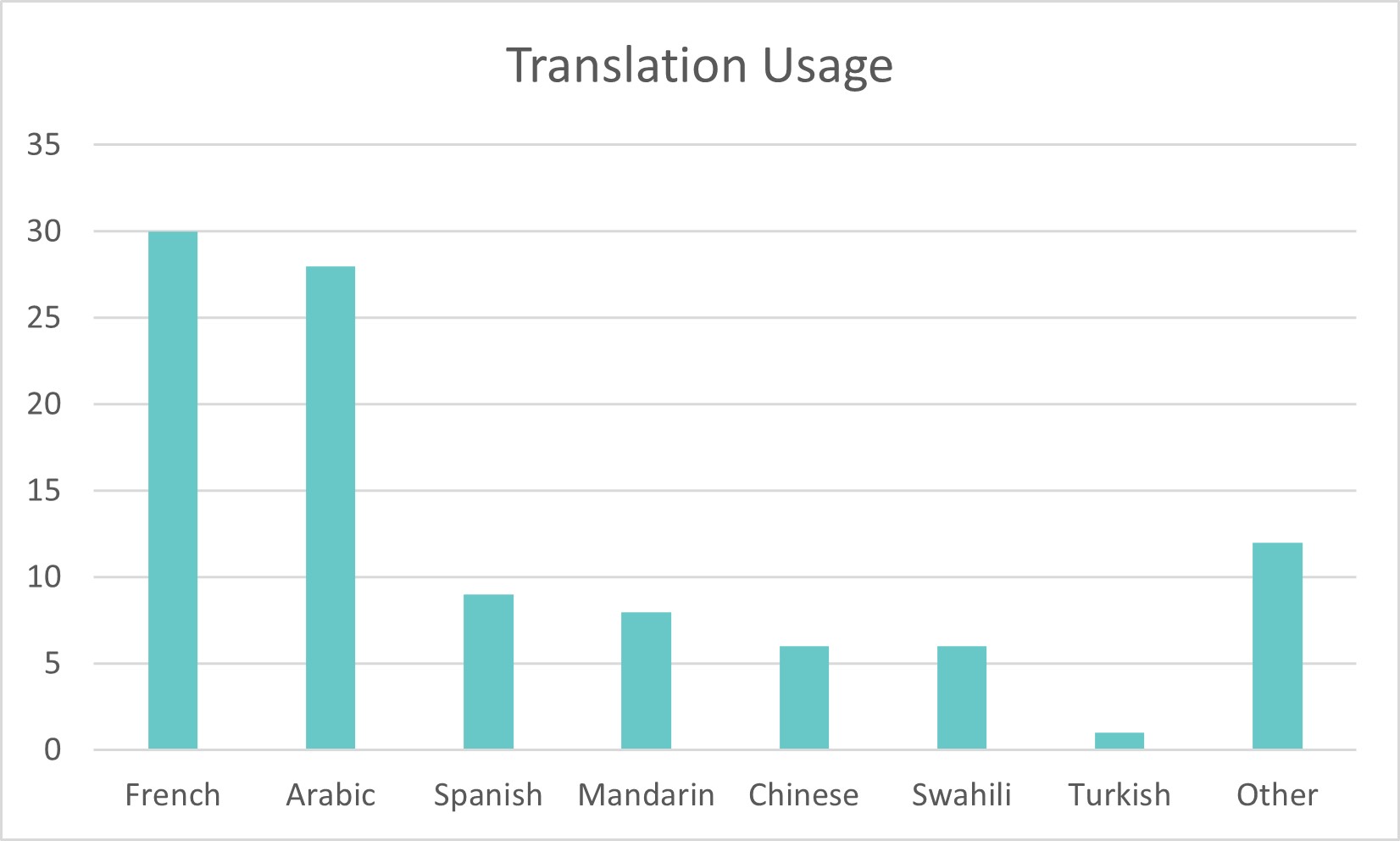
When looking at a 6-month timeframe in 2025, the translation function was activated 860 times on wechu.org. The top three languages utilized were French, Arabic, and Spanish, which made up 65% of the translation requests, with Mandarin, Chinese*, Swahili, Turkish, and “others” accounting for the remaining 35%.
*Note: “Chinese” reflects an aggregated language category used by the service provider. It generally refers to written Mandarin Chinese and does not differentiate between Simplified or Traditional script, regional variants, or spoken Chinese languages.
Graph 1. Translation usage on wechu.org, by language.
Document Translation Services
The WECHU produces a high volume of written content with important health promotion and protection information for the public and key partners. To ensure the message can be accessed by as many residents as possible, document translation services are enlisted.
As the WECHU is a designated service provider under the French Language Services Act, all Ministry of Health-related program content can be translated into French for free through the Office of French Language Health Services. The service provides content back in French and will also review any visual elements (e.g., final poster or fact sheet) that are created to ensure proper text placement and flow.
For translation into languages other than French, or for content that does not fall under ministry supported programming (e.g., work funded by an external grant), the WECHU works with Transfective Language Services. With certified translators around the world, Transfective offers 24-hour service, quick turnaround times, and translates content into hundreds of languages. The WECHU entered into a service agreement with Transfective as of October 24, 2024, following a Request for Proposal process to secure a credible, reliable, and cost-effective translation service.
Usage
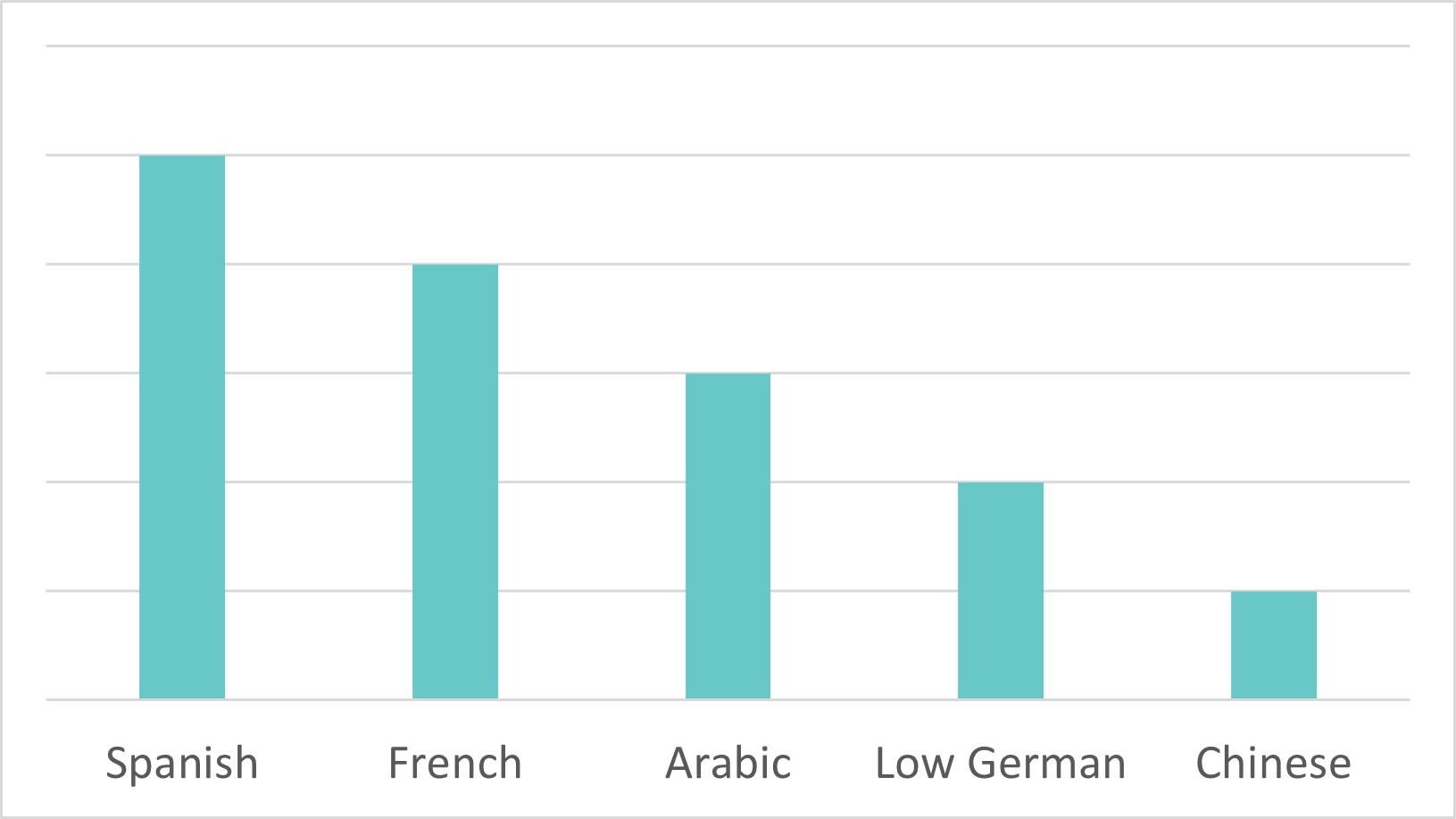
To date, use of Transfective’s services has yielded a total of 25 requests, for 19,901 words (total cost of $14,285.20). The top five languages requested have been Spanish, French**, Arabic, Low German, and Chinese*.
*Note: “Chinese” reflects an aggregated language category used by the service provider. It generally refers to written Mandarin Chinese and does not differentiate between Simplified or Traditional script, regional variants, or spoken Chinese languages.
**Note: French is requested through Transfective when the work is needed in a very timely manner. Transfective can commit to providing translated content in less than 24 hours for a rush request (at an additional cost), and outside normal office hours.
Graph 2. Top five languages requested for translation from Transfective.
Designated Staff Positions
Across the WECHU, there are specific language-designated staff positions to support clients. The WECHU has French, Arabic, and Spanish designated positions among the Comprehensive Health Promotion, Healthy Families, Immunization, and Infectious Disease Prevention departments.
Language designated staff can support the department with direct, client-facing services such as working with the local French school boards. Collecting data from our various language services helps inform us of the demand for languages per department for future staff requisitions.
French Language Services Act
The French Language Services Act (FLSA) is Ontario’s foundational legislation guaranteeing the right for clients to receive provincial government services in French. First enacted in 1986, the FLSA affirms French as an honoured and historic language in Ontario and ensures its preservation and active use in government institutions. Under the FLSA, a region is deemed French-designated if their francophone population exceeds 5,000 (or 10 percent) of the community's total population.
Purpose of the FLSA
The Act emphasizes the recognition of French as an official language in certain Canadian institutions. The FLSA ensures equitable access to services in French wherever the provincial government operates or funds services, specifically in offices located in one of Ontario’s 25 designated areas, which includes the City of Windsor and various surrounding towns. Agencies in designated areas, such as the WECHU, must proactively make French-language services visible and available from first contact through to the completion of service delivery.
FLSA Progress at WECHU
In 2025, the WECHU (through the Communications Department) was successful in securing a grant to support work which improved our compliance with the FLSA. Over the year, the following work was completed:
- French iteration of the Interactive Voice Response phone tree system recorded and installed
- Multi-lingual signage to support wayfinding in the Windsor office
- Online software provided to select staff to assist with French writing
- Clerical staff provided access to phone interpretation services for incoming calls
The WECHU submits an annual Quality Improvement Plan to the Ministry of Francophone Affairs which summarizes work completed the previous year as well as planned work for the upcoming year. Future tasks to continue working towards enhanced compliance with the FLSA includes:
- Education on the FLSA made available to WECHU staff and Board of Health members
- Investigate the integration of bilingual voicemail messages on departmental hotlines
- Develop policy framework which outlines FLSA support at the WECHU, as well as roles and responsibilities of staff (e.g., management, senior leadership)
- Develop a process to triage and address complaints received from clients around French support
Conclusion
The WECHU remains committed to fostering equitable, accessible, and culturally responsive services for all residents. Our language supports, spanning phone interpretation, website translation tools, document translation, and designated bilingual positions, reflect both the diverse needs of our community and the WECHU’s dedication to meeting clients where they are.
As we continue strengthening our alignment with the French Language Services Act and expanding multilingual resources across programs, the WECHU is well‑positioned to further enhance communication, reduce barriers, and build lasting trust with the clients we serve. Our ongoing efforts will ensure that every resident, regardless of language, can access the public health information and services they need to thrive.