







Middlesex-London Health Unit Policy Position
All alcohol manufactured or sold in Canada should have mandatory, regulated labels including health warnings, Canada’s Guidance on Alcohol and Health, and standard drink size information.
Policy Position Summary
Whereas 80% of Middlesex-London adults 19 years of age and older self-report alcohol use in the past 12 months and 29% report drinking alcohol weekly at more than a low-risk level (Middlesex-London Health Unit, 2025); AND
Whereas alcohol is classified as a Group 1 carcinogen with a causal link to cancer (IARC 2012; Rumgay, 2021); AND
Whereas many Canadians are unaware of:
- alcohol’s relationship to cancer risk, especially at low levels of consumption,
- what a standard drink of alcohol contains, and
- guidance to reduce their alcohol risk (Government of Canada, 2024); AND
Whereas alcohol is a legal product with associated health harms (Babor, 2023; Paradis, 2023); AND
Whereas alcohol containers in Canada lack comprehensive health warning labels to inform consumers of the risks or ways to reduce the risks; AND
Whereas labels are an effective tool to help consumers understand product risk (CCS, 2023; Hobin, 2022; Noar, 2016).
Therefore, the Middlesex-London Health Unit, and its Board, recommend alcohol labelling for all alcohol manufactured or sold in Canada with:
- Health Warnings: prominent, rotating warnings on all alcohol containers.
- Canada’s Guidance on Alcohol and Health: providing guidance for preventing or reducingconsumption-related health risks.
- Standard Drink Size: static standard drink information per container and per serving.
Background
Alcohol – No Ordinary Commodity
In Ontario and across Canada, alcohol availability has increased significantly over the past decade, while health protective regulations have not kept pace. Alcohol is normalized in our society as an ordinary consumer good used to celebrate, commiserate, and has even been seen as a rite of passage; however, alcohol is anything but an ordinary commodity. It is a leading risk factor for disease and injury, responsible for over 17,000 deaths and nearly 120,000 hospitalizations every year in Canada (CISUR/CCSA, 2023). Alcohol contributes to over 200 health conditions, including cancers, liver disease, cardiovascular conditions, mental health concerns, and fetal alcohol spectrum disorder (Babor, 2023; Paradis, 2023). In addition to these significant health harms, the economic and social implications of alcohol are substantial, costing Canadians $19.7 billion/year (CISUR/CCSA, 2023) which is more than the societal costs of tobacco and opioids combined.
Locally, 80% of Middlesex-London residents, aged 19 years and older, identify themselves as current drinkers and 29% report drinking above what is considered a low-risk level based on the Canadian Guidance on Alcohol and Health (Middlesex-London Health Unit, 2025). These consumption levels account for 4.1% of deaths, 2.4% of hospitalizations, and 3.8% of emergency department visits each year in Middlesex-London (Public Health Ontario, 2023). The population health burden from alcohol exceeds available capacity on already overstretched healthcare and policing systems. Furthermore, alcohol can have profound secondary harms to communities through impaired driving, intimate partner violence, and public disturbances.
Public Health Approach to Preventing Harms from Alcohol
From a public health perspective, preventing harms from alcohol consumption requires a comprehensive, organized, and multi-sectoral approach that provides controlled access to a strictly regulated product, while removing the commercial and/or industry influence. A public health approach is anchored in social justice, human rights, equity, and the application of evidence-informed policy and practice (CPHA, 2017).
Since 2024, there have been significant changes to the alcohol retail market, expanding sales to many different retail settings in Ontario, including convenience stores and grocery stores. In a cross-sectional study from Ontario, alcohol outlet density was associated with higher alcohol-attributable emergency department visits; an association that had a larger impact in low compared to high socioeconomic status neighbourhoods (Forbes, 2024).
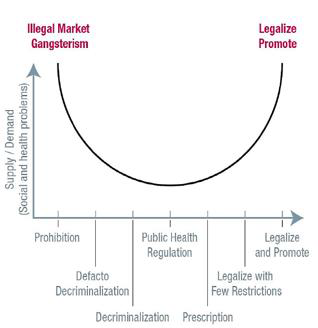
Figure 1, pictured below, shows the population health benefit to reducing health and social harms when there is a balance between alcohol availability and the enactment of measures to protect public health and safety. Through the implementation of strict public health regulations, including simple, evidence-based health warning labels on alcohol containers sold in Canada, the consumer would be informed about the health risks associated with alcohol, as well as better understand how much alcohol they are consuming, allowing for a more informed decision.
Figure 1. The Paradox of Prohibition – Adapted from Marks U-Shaped Curve (Health Officers Council of BC, 2005)
Rationale
Alcohol Labelling Supports Informed Choice by Consumers
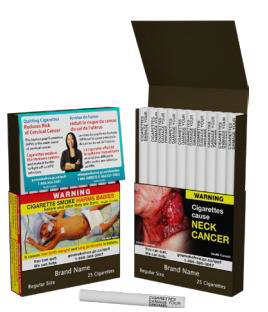
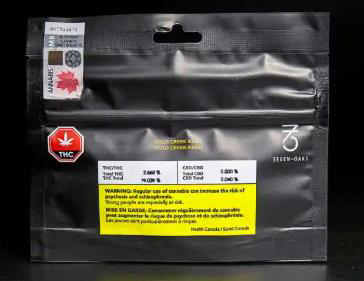
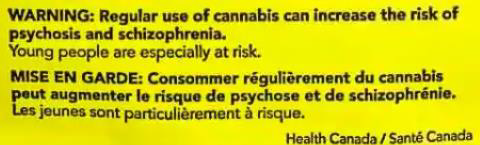
In Canada, other legalized substances like commercial tobacco products and non-medical cannabis are required to display standardized labels that include health warnings and product information to inform consumers about associated health risks and have standardized packaging designed to reduce product promotion and appeal (Government of Canada, 2023; Government of Canada, 2025). While tobacco’s labelling evolution took significant public health efforts to move from small text warnings in the 1970s to graphic health warnings and the plain packaging requirements that we see in Canada today, evidence confirms that these warning labels have increased awareness of health risks, reduced product appeal, and contributed to declines in smoking rates (Noar, 2016; CCS, 2023). The benefits of these tobacco warning labels were significant enough to influence Canada’s approach to packaging and labelling legalized, non-medical cannabis products in 2018, pictured below in Figure 2. Alcohol remains the outlier, as the only legalized substance that currently does not have a warning label.
Figure 2. Examples of tobacco and cannabis warning labels mandated by the government of Canada (CCS, 2023; Israel, 2019)
Evidence indicates that alcohol warning labels impact individuals’ knowledge, awareness, behavioural intentions, and perceptual judgements (Babor, 2023; CAPE, 2022; Correia, 2024; Hobin, 2020; WHO, 2022). Labels can reach all consumers regardless of education, income, or whether living in large urban centres or remote rural communities (Hammond, 2011), and exposure to labels is highest among those consuming the highest volume of alcohol as messaging is at point of pour.
Canadians have the right to informed decision making, including the risks associated with alcohol consumption, accurate standard drink sizing descriptions, and up-to-date guidance to help reduce their risk. The “duty to warn” obligation under product liability law could reasonably be applied to the alcohol industry since “the basic underlying rationale for the duty to warn is that consumers rely on manufacturers to provide accurate information about the risks inherent in the use of their products” (Shelly, 2021, p.268). Drawing upon lessons learned from the regulation of commercial tobacco products, warning labels are an evidence-informed policy tool that have been proven to help educate the public about the health risks associated with smoking, and instrumental in building public support for strengthening tobacco control policies, including bans on marketing and tobacco tax increases (Hammond, 2011; Noar, 2016; PHO, 2017)
Canadians Are Unaware of Health Harms from Alcohol
Alcohol is a known carcinogen and has been classified by the International Agency for Research on Cancer (IARC, 1988) as a Group 1 carcinogen for over 35 years causing at least 7 kinds of cancers and was linked to nearly 7,000 new cancer cases in Canada in 2020 (Rumgay et al., 2021). Unfortunately, most Canadians are unaware of alcohol’s relationship to cancer, especially at low levels of consumption. The Government of Canada’s 2023 Public Awareness of Alcohol-related Harms Survey confirmed that less than one-third of Canadians believe that alcohol increases the risk for breast, throat, or mouth cancers. Additionally, only one-third of Canadians were familiar with the concept of a “standard drink” and just over half of respondents were aware of Canada’s Guidance on Alcohol and Health, despite widespread promotion (Government of Canada, 2024).
The majority of Canadians agree that alcohol products should display or provide:
- the number of standard drinks;
- guidance to reduce health risks; and,
- health warnings.
Furthermore, most believe that health labelling of alcohol products would help them
- track their alcohol consumption;
- think more readily about alcohol-related harms; and,
- think about cutting back on drinking or talking to others about cutting back (Government of Canada, 2024).
Alcohol Labelling and Youth Prevention
Between 2015 and 2020, expansion of alcohol sales to approximately 450 grocery stores licensed to sell beer, wine, and cider led to increased alcohol product promotion and exposure to children and youth (Friesen, 2022). Drawing upon the lessons learned from comprehensive tobacco control, tobacco warning labels are especially effective in preventing youth initiation (Hammond, 2011; Francis, 2019). With the increased visibility of alcohol products in stores accessible to children and youth, alcohol labelling has the potential to reach them with messages that will counter industry-based advertising. The health warnings are visible to all consumers, including children and youth, on store shelves in their local convenience or grocery store. The labels also provide an opportunity for meaningful conversations between parents and their children regarding the health harms associated with alcohol.
Summary
To address complex societal problems with significant public health burden, cooperation and collaboration between local, municipal, provincial, and federal partners are required. Impacts of alcohol consumption remain a substantial population health burden, and one that exceeds social and health care system capacity. The Middlesex-London Health Unit and its Board of Health support mandatory and regulated alcohol labelling including health warnings, Canada’s Guidance on Alcohol and Health, and standard drink size on all containers of alcohol manufactured and sold in Canada. It is a modest and evidence-informed policy that ensures that consumers are aware of the health harms associated with alcohol and is in alignment with Canada’s approach to commercial tobacco products and the legalization of non-medical cannabis.
References
Babor, T., Casswell, S., Graham, K., Huckle, T., Livingston, M., Österberg, E., Rehm, J., Room, R., Rossow, I., & Sornpaisarn, B. (2023). Alcohol: No ordinary commodity: Research and public policy (Third edition). Oxford University Press. https://pnsd.sanidad.gob.es/profesionales/publicaciones/catalogo/bibliotecaDigital/publicaciones/pdf/2023/Babor_TF_Alcohol_No_Ordinary_Commodity_2023.pdf
Canadian Alcohol Policy Evaluation (CAPE) 3.0 Project Team. (2022, June). Evidence-based recommendations for labelling of alcohol products in Canada. https://www.uvic.ca/research/centres/cisur/assets/docs/cape/cape-eviden…
Canadian Cancer Society (CCS). (2023, October). Cigarette Package Health Warnings: International Status Report, Eighth Edition. https://cdn.cancer.ca/-/media/files/about-us/media-releases/2024/international-warnings-report/ccs-international-cigarette-packaging-report-2023-english.pdf?rev=8b7d0cda6cf049eaa1894ee1dea37b8c&hash=C4A685E791A8338E0824212C84F5CBA8&_gl=1*m2otxb*_gcl_au*ODc1MzMwMDI5LjE3NjI4MDY1MTY
Canadian Institute for Substance Use Research (CISUR) and the Canadian Centre on Substance Use and Addiction (CCSA). (2023). Canadian substance use costs and harms 2007–2020. https://csuch.ca/assets/documents/reports/english/Canadian-Substance-Use-Costs-and-Harms-Report-2007-2020-en.pdf
Canadian Public Health Association (CPHA). (2017, March). Public Health: A Conceptual Framework. https://www.cpha.ca/sites/default/files/uploads/policy/ph-framework/phcf_e.pdf
Correia, D., Kokole, D., Rehm, J., Tran, A., Ferreira-Borges, C., Galea, G., Likki, T., Olsen, A., & Neufeld, M. (2024). Effect of alcohol health warning labels on knowledge related to the ill effects of alcohol on cancer risk and their public perceptions in 14 European countries: an online survey experiment. The Lancet Public Health. 9(7), e470-e480. https://www.sciencedirect.com/science/article/pii/S2468266724001026?via%3Dihub
Forbes, S., Schwartz, N., Fu, SH., Hobin, E., & Smith, B. (2024) The association between off- and on-premise alcohol outlet density and 100% alcohol-attributable emergency department visits by neighbourhood-level socioeconomic status in Ontario, Canada. Health & Place. 89,1-9. https://doi.org/10.1016/j.healthplace.2024.103284
Francis, D., Mason, N., Ross, J., & Noar, S. (2019) Impact of tobacco-pack pictorial warnings on youth and young adults: A systematic review of experimental studies. Tobacco Induced Diseases. 15(17),41. https://pmc.ncbi.nlm.nih.gov/articles/PMC6662785/
Friesen, E., Staykov, E., & Myran, D. (2022). Understanding the association between neighbourhood socioeconomic status and grocery store alcohol sales following market liberalization in Ontario, Canada. Canadian Journal of Public Health. 114, 254-263. https://pmc.ncbi.nlm.nih.gov/articles/PMC10036712/
Government of Canada. (2023, July 26). Tobacco Product Labelling. https://www.canada.ca/en/health-canada/services/health-concerns/tobacco/legislation/tobacco-product-labelling.html
Government of Canada. (2024, January 19). Public awareness of alcohol-related harms survey 2023 [Web Summary]. Health Infobase. https://health-infobase.canada.ca/alcohol-related-harms-survey/
Government of Canada. (2025, July 15). Packaging and labelling guide for cannabis products. https://www.canada.ca/en/health-canada/services/cannabis-regulations-licensed-producers/packaging-labelling-guide-cannabis-products.html#a72
Hammond, D. (2011). Health warning messages on tobacco products: A review. Tobacco Control. 20(5): 327-37. https://tobaccocontrol.bmj.com/content/20/5/327
Health Officers Council of British Columbia. (2005, October). A Public Health Approach to Drug Control in Canada: Discussion Paper. http://www.cfdp.ca/bchoc.pdf.
Hobin E., Weerasinghe A., Vallance K., Hammond D., McGavock J., Greenfield TK., Schoueri-Mychasiw N., Paradis C., & Stockwell T. (2020). Testing Alcohol Labels as a Tool to Communicate Cancer Risk to Drinkers: A Real-World Quasi-Experimental Study. Journal of Studies on Alcohol and Drugs. 81(2): 249-261. https://pmc.ncbi.nlm.nih.gov/articles/PMC7201213/
Hobin, E., Jansen, R., Vanderlee, L., & Berenbaum, E. (2022). Enhanced alcohol container labels: A systematic review. Ottawa, Ont.: Canadian Centre on Substance Use and Addiction. https://www.ccsa.ca/sites/default/files/2022-02/CCSA-Enhanced-Alcohol-Container-Labels-Systematic-Review-Report-en.pdf
International Agency for Research on Cancer (IARC). (1988). Monographs on the Evaluation of Carcinogenic Risks to Humans - Alcohol Drinking (44). https://publications.iarc.who.int/Book-And-Report-Series/Iarc-Monographs-On-The-Identification-Of-Carcinogenic-Hazards-To-Humans/Alcohol-Drinking-1988
International Agency for Research on Cancer (IARC). (2012). Monographs on the Evaluation of the Carcinogenic Risks to Humans – Personal Habits and Indoor Combustions (100E) https://publications.iarc.who.int/122
Middlesex-London Health Unit. (2025, October 3). Community health status resource - substance use: Alcohol Use. https://app.powerbi.com/view?r=eyJrIjoiOTZlMTRmNmEtNDI4Ni00MTBkLTlmYjUtZTAwN2YwYWVlMmVhIiwidCI6ImRjNTYxMjk1LTdjYTktNDFhOS04M2JmLTUwODM0ZDZhOWQwZiJ9
Noar, S., Francis, D., Bridges, C., Sontag, J., Ribisl, K., & Brewer, N. (2016). The impact of strengthening cigarette pack warnings: Systematic review of longitudinal observational studies. Social Science & Medicine, 164: 118-129. https://www.researchgate.net/publication/305341963_The_impact_of_strengthening_cigarette_pack_warnings_Systematic_review_of_longitudinal_observational_studies
Ontario Health and Ontario Agency for Health Protection and Promotion (Public Health Ontario). (2023). Burden of Health Conditions Attributable to Smoking and Alcohol by Public Health Unit in Ontario (Appendix A: Estimates). https://www.publichealthontario.ca/-/media/Documents/B/2023/burden-health-smoking-alcohol-appendix-a-etimates.pdf?rev=5d7b233ef2d546e89a6688a4322603e4&sc_lang=en&hash=05C974A08333AE879DFCD20AE4C9A836
Paradis, C., Butt, P., Shield, K., Poole, N., Wells, S., Naimi, T., Sherk, A., & the Low-Risk Alcohol Drinking Guidelines Scientific Expert Panels. (2023). Canada’s Guidance on Alcohol and Health: Final Report. Canadian Centre on Substance Use and Addiction. https://www.ccsa.ca/sites/default/files/2023-01/CCSA_Canadas_Guidance_on_Alcohol_and_Health_Final_Report_en.pdf
Public Health Ontario (PHO). (2017, April). Evidence to Guide Action: Comprehensive tobacco control in Ontario (2016). https://www.publichealthontario.ca/-/media/Documents/C/2017/comprehensive-tobacco-control-2016.pdf?rev=0bb7b789399d4586b68c9dfa1a0396a8&sc_lang=en
Rumgay, H., Shield, K., Charvat, H., Ferrari, P., Sornpaisarn, B., Obot, I., Islami, F., Lemmens, V., Rehm, J., & Soerjomataram, I. (2021). Global burden of cancer in 2020 attributable to alcohol consumption: a population-based study. The Lancet Oncology, 22(8),1071-1080. https://www.thelancet.com/journals/lanonc/article/PIIS1470-2045(21)00279-5/fulltext
Shelley, J. (2021). A reflection on the duty to warn after Létourneau v JTI-MacDonald: A future for obesity litigation in Canada? McGill JL & Health. 159,14(2): 255-310. https://mjlh.mcgill.ca/wp-content/uploads/2022/04/14.2-shelley-.pdf
Israel, S. (2019, June 17). Canada’s cannabis health warning messages get overhaul. Winnipeg Free Press. https://www.winnipegfreepress.com/arts-and-life/life/cannabis/2019/06/17/canadas-cannabis-health-warning-messages-get-overhauled
World Health Organization (WHO). (2022). Health warning labels on alcoholic beverages: opportunities for informed and healthier choices (Snapshot series on alcohol control policies and practice. Brief 4, 8 November 2021). https://iris.who.int/server/api/core/bitstreams/e2dfdb09-f808-4f5d-8e91-51c7c7628080/content