







Meeting Date
Meeting Document Type
Minutes
Finance and Audit Committee Meeting Minutes
Monday, November 10, 2025 – 2:00 pm – 4:00 pm
via Microsoft Teams
Audit Committee Members: Renaldo Agostino, Dr. Mark Awuku, Robert Maich
Audit Committee Regrets:
Guests: Board Chair Joe Bachetti
Administration: Dr. Ken Blanchette, Emily Durance (recorder), Michael Horrobin
QUORUM: Confirmed
- Call to Order: Dr. Awuku, Chair
- Move to In-Camera
Motion: That the meeting move to in-camera.
Moved by: R. Maich
Seconded by: Dr. Awuku
CARRIED
The committee moved In-Camera at 2:02 p.m. - Agenda Approval
Motion: That the agenda be approved.
Moved by: R. Maich
Seconded by: Dr. Awuku
CARRIED - Declaration of Conflict of Interest - None
- Move to In-Camera
- Approval of Minutes – September 8, 2025
Motion: That the minutes from the September 8, 2025 meeting be approved.
Moved by: Dr. Awuku
Seconded by: R. Agostino
CARRIED - Q3 Financial Report (for approval) (M. Horrobin)
- Ended September 30, 2025.
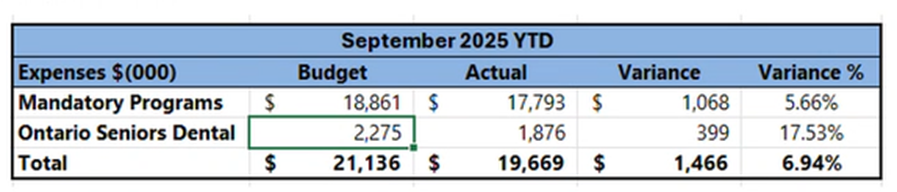
The WECHU continues to have underspending due to vacancies, which are significant. Often times, it tends to take two to three months to fill a vacancy.
The WECHU budgets conservatively to ensure we avoid overspending. All positions are budgeted at the maximum rate, with the exception of the manager positions.
Benefits follow salaries, OMERS pension plan is very high. If there is a salary gapping, there will be a lot of benefit gapping as well.
Professional fees are overbudgeted as of September. There were several labour relations cases that required legal assistance, the Leamington building lease was renegotiated, and legal costs associated with Phase I of the Facility Renewal Project.
Supplies and Programs are underbudgeted, and this is a timing issue. This budget line item should be in line by the end of December. This is largely a seasonal program, so expenses come in at the end of the year.
For the Ontario Seniors Dental program, there is a $398K underspend as of September 30, 2025. This is also due to salaries and benefits. There have been a number of vacancies in this particular program. Clinical supplies are under budget. The usage was not at the levels we anticipated. Purchased services is related to contracts with outside dental offices. We are also outsourcing clients for dentures. There are three different arrangements for denturists to assist with a long wait list for dentures.
M. Horrobin’s forecasted Mandatory budget underspend of $804K is largely due to salaries and benefits.
The Healthy Babies Healthy Children program is under the Ministry of Children, Community and Social Services that runs to March 31st. We are on budget with this program. Forecasted to be on budget by the end of March 2026. - 2026 Budget (M. Horrobin)
Our budget year aligns with the municipal year end of December 31st.
The MOH annually grants funding up to a maximum of 75%, obligated municipalities are funding to a minimum of 25%.
Updated OPHS standards will be in effect January 1, 2026.
Starting in 2027, we are uncertain on the funding from the Ministry, which adds an element of uncertainty.
A comprehensive program prioritization exercise was undertaken in July that looks at programs and determines effectiveness of the programs and the impact on the community.
Three additional FTEs were added to the 2026budget into the Comprehensive Health Promotion, Substance Use Prevention & Harm Reduction, and the Infectious Disease Programs as these are areas with a real need in the community.
By the end of 2025, Phase 1 of the facility renewal project will conclude. This phase included extensive renovations on the first floor of the building. Phase I was approximately $660K to include project management fees, construction costs, and permits/fees.
A request for the facility renewal project was made to the Ministry for a one-time amount of $1.1 million that must be spent by March 31,2026. The Ministry has not yet approved this one-time funding.
In 2026, with board approval, Phase 2 will commence to include extensive renovations to the second floor. $300K has been allocated in the 2026 Mandatory programs budget.
One-time funding requests are in for 2025/2026. One-time money that comes in from the province is on their fiscal year (April 1/25 – March 31/26). The requests have not been approved by the Ministry.
Average wage increases of 2.8% We were able to reduce salaries by shifting some FTE salary to the Infection Prevention and Control Hub (IPAC) which is 100% Ministry funded. This past Friday, we received the approval for IPAC hub funding.
M. Horrobin reported that when putting together the budget, anticipated vacancies are considered.
R. Maich asked about the Public Health Inspector Practicum program. Dr. Blanchette responded that four Masters of Public Health students are paid for their involvement in the vector-borne and larvicide program. The cost of the program is $163100. The WECHU advocated last year for this program to continue.
Dr. Blanchette added that he has taken part in discussions with the ministry regarding changes in the funding model for 2027. M. Horrobin and Dr. K Blanchette will be building a business plan to be able to provide facts and data for a proper funding model for our Health Unit.
The WECHU is asking for 1% from the obligated municipalities, which totals up to $72,902 in the contributions.
The proposed budgeted total net expenditures are $25,459,000 representing a 1% increase over the 2025 budget.
The Ontario Seniors Dental Care Program is 100% funded by the ministry. We are not receiving an increase in the overall budget. We were informed by the Ministry to keep the funding at the same amount. The budget for this program is $3,032,800.
M. Horrobin highlighted some budget challenges and risks for the new budget.
The WECHU adopted the new Ontario Public Health Standards in 2024. There are still some protocols that are not completely defined by the Ministry yet.
Funding increases are not keeping up with overall operating expense increases.
PROPOSED MOTION
Whereas, the Windsor-Essex County Health Unit receives grants annually from the Ministry of Health to a maximum of seventy-five (75%) percent of admissible expenditures associated with the Mandatory Program. In addition, WECHU receives required contributions from the Obligated Municipalities at a minimum of twenty-five (25%) percent of admissible expenditures, and
Whereas, the Ministry of Health annually provides grants for certain related health protection and promotion programs at a rate of one hundred (100) percent of admissible expenditures.
Now therefore be it resolved that the Finance and Audit Committee recommend the approval of the 2026 Mandatory Programs Budget, requiring $18,096,000 (71.1%) in base funding from the Ministry of Health and $7,363,110 (28.9%) in contributions from the Obligated Municipalities, the Corporation of the City of Windsor, the Corporation of the County of Essex, and the Corporation of the Township of Pelee, be approved.
Further that, the Finance and Audit Committee recommend the approval of the 2026 Mandatory Programs Budget with total expenditures of $25,459,110, and offset revenue of $758,700, and
Further that, the Finance and Audit Committee recommend for approval the 2026 Ontario Seniors Dental Care Program, funded at a rate of one hundred (100) percent with total budgeted expenditures of $3,032,800.
Motion: That the above resolution be approved.
Moved by: R. Maich
Seconded by: R. Agostino
CARRIED - Reserve Fund – Recommendation for Approval (Dr. K. Blanchette)
Dr. Ken Blanchette provided the rationale for the WECHU’s request for a reserve fund.
Our budget is a combined budget of capital and operating; creates difficulties as the vast majority of our pressures comes from salaries.
Every year, we have been annually reducing our capital allotment to compensate for salary increases.
Gapping dollars are relied upon substantially to address capital needs which makes capital planning problematic.
The WECHU’s traditional approach is to use gapping dollars if available towards the capital and one-time operating expenditures. If approval is granted in traditional timelines, gapping dollars return without time to spend.
The aging capital and building are dependent on gapping dollars, timing, procurement process, and supply chain.
Currently, the WECHU is still awaiting approval from the ministry on $1.1 million. If we do not proceed with the project and receive the funds, the funds will have to be returned to the ministry. If we proceed with the project and do not receive the one-time funding of $1.1 million, we risk overspending on the budget.
The reserve would be built on unused funds from the municipal portion. It would reduce risk, create flexibility to act and enable long-term capital planning.
A peer review was conducted with twenty-eight other Health Units. Of the sixteen Health Units who responded, thirteen have or have access to a reserve fund, three have no reserve fund, and two are actively pursuing a reserve fund.
The permitted uses of the reserve fund would include:
Capital purchases
Major construction/renovation projects
Unforeseen liabilities or unanticipated program/corporate expenses not reasonably foreseeable during the annual budgeting process
Temporary funding of BOH approved business cases expected to receive 100% MOH reimbursement
Support for emergent public health needs to ensure timely response
R. Maich added that it’s important that other stakeholders who see this request understand that it is a measure to assist with stability, planning and predictability.
After looking at other Health Units who have reserves, there are set parameters for use of the reserve. Dr. Blanchette responded that other Health Units do have set parameters and we used existing policies as a template for our WECHU reserve policy.
J. Bachetti added that it is important to do what we can to maximize the dollars.
PROPOSED MOTION
Whereas, the Windsor-Essex County Health Unit (“WECHU”) does not currently maintain a reserve fund to mitigate financial risks arising from delayed funding approvals or to respond to emergent public health needs;
Whereas, provincial grants are subject to year-end restrictions and specific conditions imposed by the funder, whereas contributions from the Obligated Municipalities may be allocated in accordance with the Health Unit’s statutory authority; and
Whereas, the Municipal Act, 2001 expressly authorizes local boards, including boards of health, to establish and maintain reserve funds for any purpose within their spending authority; and
Whereas the establishment of a reserve fund is a prudent financial management practice that will support WECHU’s ability to respond to funding delays, address urgent public health priorities, and reduce financial risk to the Obligated Municipalities.
Now therefore be it resolved that the Finance & Audit Committee recommend to the Board of Health the following for approval:
That the Reserve Fund Policy, as presented, be approved.
That a Reserve Fund be established in accordance with the approved policy; and
That all municipal year-end surplus dollars, as identified in the audited financial statements for the year ended December 31, 2025, be allocated to the newly established Reserve Fund.
Motion: That the above resolution be approved.
Moved by: R. Maich
Seconded by: R. Agostino
CARRIED - Next Meeting: At the Call of the Chair, or Monday, February 26, 2026
- Adjournment
Motion: That the meeting move out of in-camera and be adjourned.
Moved by: R. Agostino
Seconded by: R. Maich
CARRIED
The meeting moved out of in-camera and adjourned at 3:28 p.m.
- Ended September 30, 2025.
RECORDING SECRETARY: E. Durance
SUBMITTED BY: K. Blanchette
APPROVED BY: Finance & Audit Committee