
March 2026 Board of Health Meeting - Minutes
Board Members Present:
Renaldo Agostino, Dr. Mark Awuku, Dr. Jennifer Bondy, Frazier Fathers, Fred Francis, Dr. Sardar Khan, Hilda MacDonald, Angelo Marignani, Jennifer Nugent, Michael Prue, Rob Shepley
Board Member Regrets:
Joe Bachetti, Robert Maich, Jennifer Yee
Administration Present:
Dr. Mehdi Aloosh, Dr. Ken Blanchette, Michael Horrobin, Kristy McBeth, Eric Nadalin, Dorothea Service, Dan Sibley, Emily Durance (recorder)
Board Chair
Angelo Marignani (chairing on behalf of Joe Bachetti)
QUORUM: Confirmed
- Call to Order
Board of Health Vice-Chair, A. Marignani, called the meeting to order at 3:09 p.m.- Land Acknowledgement – Read by Board Vice-Chair, A. Marignani
- Quorum – Confirmed at 3:09 p.m.
- Declaration of Conflict of Interest – none
- Approval of Agenda
Motion: That the agenda be approved as presented.
Moved by: Renaldo Agostino
Seconded by: Dr. Jennifer Bondy
CARRIED - Approval of Minutes: February 5, 2026
Motion: That the minutes be approved.
Moved by: Frazier Fathers
Seconded by: Rob Shepley
CARRIED - Medical Officer of Health Update (Dr. Mehdi Aloosh)
Dr. Mehdi Aloosh presented on infant and maternal health in Windsor-Essex and shared some important local data.
Reproductive health is a key indicator of overall population health, reflecting the physical, mental and social well-being of individuals.
According to Public Health Ontario’s Health Equity Snapshot, infants born in the most materially deprived neighbourhoods in Windsor‑Essex County experienced a low-birth-weight rate 2.29 times higher than those in the least deprived neighbourhoods, based on combined 2021–2022 data.
Dr. Aloosh shared the types of mental health concerns seen by mothers in Windsor-Essex County in 2025 including anxiety and depression. He added that the data shows that cannabis use during pregnancy in our region is higher than the rest of the province.
Dr. Aloosh concluded by stating that a healthy future begins with healthy babies, healthy mothers, and healthy pregnancies. - Consent Agenda
- Information Reports (for information)
- Communications Reports:
- February 2026
- PHO and Local Immunization Coverage Rates 2024-2025 School Year
- WECOSS Action Plan Renewal
- Secondary School Food Handler Certification Collaboration
- Finance & Audit Committee Meeting Minutes – November 10, 2025
- Building Blocks for Better Babies Program
- Outcomes of the Peer Advisory Committee
- 2025 Privacy Summary Report
- KPMG Audit Planning Report – for the year ended December 31, 2025
- Town of Essex – Letter of Support – Adverse Childhood Experiences Local Policy Advancement
Motion: That the Consent Agenda be approved as presented.
Moved by: Renaldo Agostino
Seconded by: Frazier Fathers
CARRIED
- Communications Reports:
- Information Reports (for approval)
- WECHU Letter of Support – Endorsement of Middlesex – London Health Unit Policy Position on Alcohol Labelling
Motion: That the above letter of support be endorsed by the Board.
Moved by: Rob Shepley
Seconded by: Fred Francis
CARRIED
- WECHU Letter of Support – Endorsement of Middlesex – London Health Unit Policy Position on Alcohol Labelling
- Information Reports (for information)
- Correspondence (Dr. Ken Blanchette)
- Middlesex-London Health Unit– Alcohol Labelling Policy Position (for information)
- Northwestern Health Unit – Endorsement of MLHU Position Paper on Alcohol Labelling (for information)
Motion: That the above Correspondence be received.
Moved by: Fred Francis
Seconded by: Dr. Jennifer Bondy
CARRIED
- Business Arising - none
- Resolutions/Recommendation Reports (for approval)
- Advocating for Enhanced Controls Around Social Media for Children and Youth (Kristy McBeth)
This item originated from a suggestion made by a WECHU board member during the March board meeting.
The update focused on recommendations specific to social media, highlighting associated mental health and sleep risks for children and youth.
Speaks more to the recommendations around social media.
Recommendations to federal and provincial governments include implementing preventive regulatory measures, such as age limits, enhanced age-verification systems, and other evidence-based policies.
Early guidance to delay social media use in young children was emphasized.
Board member, Renaldo Agostino asked whether device use was considered; Kristy McBeth clarified that last month’s resolution addressed overall screen time and digital dependence, but not specific device types.
PROPOSED MOTION
Whereas, the Ontario Public Health Standards (OPHS) call for identifying emerging health risks, reducing inequities and creating supportive environments; and
Whereas, social media use is widespread among children and youth with growing evidence linking frequent and problematic use to anxiety, depression, low self-esteem, sleep disruption, cyberbullying, and emotional dysregulation;1,2 and
Whereas, social media platforms are deeply embedded in young people’s communication, yet excessive or uncontrolled use can negatively affect their mental, emotional, and physical health; and
Whereas, children and youth are in a critical period of brain development, making them particularly vulnerable to digital environments designed to maximize engagement which may exploit developmental vulnerabilities, including emerging impulse control and heightened reward sensitivity.
Now therefore be it resolved that, the Windsor‑Essex County Board of Health calls on the federal and provincial government to implement policies and regulatory measures that promote healthy social media use, prevent exposure to harmful content, and prioritize the well‑being of children and youth, including advancing Bill C-63 (Online Harms Act) to strengthen timely protections; and
Further that, the Windsor‑Essex County Board of Health encourages the province of Ontario to establish evidence‑based policies including minimum age limits on social media use, mandating age‑appropriate design standards, strengthening age-verification systems, and increasing platform accountability; and
Further that, the Windsor‑Essex County Board of Health recommend that local health care providers integrate discussions about social media use into routine visits with children and youth, including screening for problematic use, sleep disruption, and mental health impacts, and offering evidence‑informed guidance.
Whereas, nearly all children in Canada are exposed to screens by the age of 2, and limiting technology at a young age is important as early screens use can impact language and cognitive development as well as social emotional health; and
Whereas, locally in Windsor-Essex County, 82% of youth in grades 7 to 12 report spending 3 hours or more a day on screens; displacing important health behaviours like being active, adequate sleep, outdoor play, and in-person social interactions; and
Whereas, promoting digital literacy is essential in mitigating negative social, emotional, developmental, and overall health effects of technology use; and
Whereas, parents, caregivers, and educators play a critical role in modeling positive technology habits and supporting digital literacy; and
Whereas, addressing problematic technology use requires a comprehensive, community-driven approach involving collaboration between childcare centers, schools, families, healthcare providers, and policymakers to create supportive environments and interventions; and
Now therefore be it resolved that the Windsor-Essex County Board of Health encourages community partners working with pre-school and school aged children to collaborate on the co-development of strategies that help build healthy technology habits and manage digital use; and
FURTHER THAT, the Windsor-Essex County Board of Health will lead collaborative efforts with schools, childcare centres, and community partners to provide consistent messaging and strategies to reduce problematic technology use and its effects on emotional regulation, mental health, sleep, physical activity, and relationships; and
FURTHER THAT, the Windsor-Essex County Board of Health calls on local healthcare providers to integrate conversations about technology use and its effects on development and well-being into well-baby visits and annual checkups; and
FURTHER THAT, the Windsor-Essex County Board of Health recommends that healthcare providers and community organizations provide parents/caregivers tools and resources to identify signs of problematic technology use and guidance on how to seek appropriate support.
Motion: That the above resolution be approved as presented.
Moved by: Renaldo Agostino
Seconded by: Dr. Jennifer Bondy
CARRIED - Governance Standing Committee (Angelo Marignani)
- Governance Standing Committee Terms of Reference
The Governance Standing Committee is responsible for ensuring legislative compliance and supporting effective Board governance. Their duties include Board oversight, CEO & MOH performance reviews, appointment term management, and assessing Board member performance.
The Terms of Reference for the Governance Standing Committee were presented for approval by the Board. There were no concerns.
During discussion, Dr. Bondy inquired about the use of anonymous feedback in evaluating the CEO and MOH. Dr. Blanchette noted that evaluations typically involve selected community partners and direct reports using a structured tool focused on how the CEO and MOH engage with stakeholders. Dr. Sardar Khan asked about establishing criteria and questions for the Governance Standing Committee to use in this process.
Motion: That the Governance Standing Committee Terms of Reference be approved as presented.
Moved by: Dr. Sardar Khan
Seconded by: Frazier Fathers
CARRIED
- Governance Standing Committee Terms of Reference
-
2026 ASP One-Time Funding Business Case (Michael Horrobin)
The Board must approve the one-time business cases for submission to the Ministry of Health by March 31, 2026.
Requests fall under urgent and critical capital needs (up to $1.1M) and Public Health Inspector practicums.
Four requests are being made this year; facility renewal project ($1.1M), immunization product refrigerators ($310K), public health inspector practicum program ($163K), and temperature and access-controlled storage units ($30K).
PROPOSED MOTION
Whereas, the Board of Health for the Windsor-Essex County Health Unit has approved the 2026 Budget which included budget information for the Mandatory Programs funded by the MOH and the Obligated Municipalities on a cost shared basis and the Ontario Seniors Dental Care Program funded at a rate of 100% by the MOH.
Whereas, the WECHU is required to submit is Annual Service Plan and Budget Submission to the MOH on March 31, 2026, inclusive of the aforementioned budget approvals as well as additional requests for one-time 100% funded business cases from the MOH, and
Now therefore be it resolved that the Windsor-Essex County Board of Health approve the following additional one-time business cases to be funded at a rate of 100% by the MOH: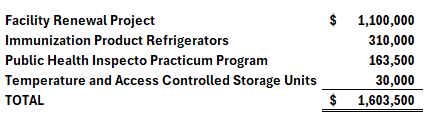
Motion: That the above resolution be approved as presented.
Moved by: Fred Francis
Seconded by: Dr. Mark Awuku
CARRIED
- Advocating for Enhanced Controls Around Social Media for Children and Youth (Kristy McBeth)
- New Business
- WECHU Priority Population Engagement Strategy Update
(Dominique Chauvin/Darcie Renaud/Ray Reaume/Jiji Pulos)
This strategy focuses on reducing health inequities by engaging individuals with lived experience and is aligned with the new strategic plan.
The advisory committees are modelled on hospital-based patient engagement frameworks, with WECHU being the first health unit to implement this approach.
Two committees are currently active: 2SLGBTQIA+ and People with Lived and Living Experience of Substance Use.
Committee member, Jiji Pulos, shared that members of the 2SLGBTQIA+ committee participated in structured priority-setting, community engagement discussions, consultations, internal policy development, and co‑design of interventions using logic models.
Committee member, Ray Reaume, identified three priority areas: inclusive sexual health education and safer school environments; visibly welcoming and affirming community spaces; and access to gender‑affirming care. R. Reaume noted that participation in the committee has fostered connection within the community and ensured members feel heard.
J. Pulos shared that participation on the Youth Advisory Committee increased their understanding of WECHU’s work and motivated them to share this experience with peers, noting the value of being involved and heard.
R. Reaume added that seeing actual results from the input they have provided has been a game changer.
Darcie Renaud thanked Ashley Kirby and Melissa Valentik (WECHU Health Promotion Specialists) for facilitating the committees.
Health Promotion Specialist, Dominique Chauvin, stated that a clear mission and values were established for the Peer Advisory Committee (PAC). Members contributed to education initiatives and supported opioid agonist therapy workshops. Participants reported feeling meaningfully engaged and that their feedback was valued. WECHU will continue engaging the PAC and build on this momentum in 2026 to strengthen its presence and demonstrate impact.
Board member, Renaldo Agostino, asked whether additional populations would be engaged. D. Renaud noted future focus areas may include at‑risk mothers (e.g., low‑SES, younger, and single mothers) within Healthy Families, as well as a group within Infectious Diseases; some committees may be standing, while others may be project‑specific.
Board member, Dr. Mark Awuku, inquired about PAC member selection. Staff advised recruitment occurs through community partners, post‑secondary outreach, school nurses, social media, and both physical and digital promotional materials.
Motion: That the above information be received by the Board.
Moved by: Renaldo Agostino
Seconded by: Dr. Mark Awuku
CARRIED - Healthy Babies Healthy Children Program (Dorothea Service)
The Board of Health approved a resolution during the November 2025 board meeting which spoke to Adverse Childhood Experiences (ACEs).
Director of Public Health Services, Dorothea Service, shared that we are seeing those trends within our Healthy Babies Healthy Children program.
The HBHC program serves as a key intervention to improve family health outcomes. It operates through two branches: home visiting and nurse practitioner clinical services.
Home visiting activities include referrals, comprehensive assessments, and visits by nurses or family home visitors. The program effectively delivers the top six family‑identified service plan goals, demonstrating strong capacity to support and retain families.
D. Service shared that the WECHU is transitioning away from providing nurse practitioner services as this is a highly targeted program. Emphasis has shifted toward strengthening linkages with community partners to ensure more comprehensive and sustained care. All clients have been successfully connected to primary care services.
Staff are mobilizing evidence‑based HBHC programs and thanked the Board for approving the ACEs resolution, which helped identify health trends and guide resource reinvestment. Enhanced staff training is underway to strengthen interventions for families. Program indicators are being developed to assess the effectiveness of home visiting services, alongside a transition away from nurse practitioner services toward stronger integration with comprehensive community providers.
Board member, Frazier Fathers, asked whether metrics would be established for the home visiting program and how outcomes would be benchmarked. D. Service advised that metrics will be informed by population health assessments and evidence-based literature, including selective indicators such as cannabis use, with reassessment following referral. She added that measuring health outcomes remains a challenge.
Board member, Dr. Sardar Khan, asked about the capacity of the team. D. Service responded that the program includes 16 nurses, 2 family home visitors, and 2 social workers. Services are delivered by referral, and the current wait time is 1-3 weeks.
Motion: That the above information be received by the Board.
Moved by: Fred Francis
Seconded by: Rob Shepley
CARRIED - 2026/2027 Budget for Programs Funded by MCCSS (Michael Horrobin)
Director of Corporate Services and Chief Financial Officer, Michael Horrobin, presented the 2026/2027 budget for programs funded by the Ministry of Children, Community and Social Services for approval. (The budget year is from April 1, 2026 – March 31, 2027.)
The budget had been frozen for several years until 2026; however, funding levels will remain frozen through 2030.
Salary pressures reflect wage increases, maternity leave top-ups, and higher benefit costs. A vacancy factor has been incorporated into the salaries budget.
Program activity levels continue to exceed established targets.
PROPOSED MOTION
Whereas, The Windsor-Essex County Health Unit receives grants from the Ministry of Children, Community and Social Services to fund the Healthy Babies Healthy Children Program.
And Whereas, the total budgeted expenditures for the Program for the period April 1,2026 to March 31, 2027 are $3,091,990.00
And Whereas, at its meeting of February 26,2026, the Finance and Audit Committee passed a motion recommending to the Board of Health the approval of the MCCSS operating budget for the period April 1,2026 to March 31,2027
Now therefore be it resolved that the Board of Health approve the MCCSS operating budget for the period April 1,2026 to March 31,2027
Motion: That the above resolution be approved as presented.
Moved by: Renaldo Agostino
Seconded by: Michael Prue
CARRIED - Food Insecurity Compromises Maternal and Infant Health (Jennifer Jacob)
Food insecurity significantly impacts maternal and infant health. WECHU Nutritionist, Jennifer Jacob, shared that one in four households experience food insecurity.
Women who experience food insecurity during pregnancy are more likely to experience issues with mental health.
It is important to note that negative effects can be mitigated when identified early in pregnancy.
The Hunger Vital Signs screening tool identified 72 clients who screened positive and were referred for specialized supports. In 2026, the WECHU will promote this screening tool to obstetric, pediatric, primary care, and midwifery providers. Partners will be informed of the HBHC program, Building Blocks for Better Babies program, and WECHU breastfeeding classes.
Key gaps were identified, including timely access to breastfeeding support and emergency infant formula. J. Jacob noted plans to address these gaps through strengthened local partnerships.
The Board discussed rising infant formula costs, shortages, and equity concerns. WECHU will begin tracking local formula costs to support advocacy and explore emergency reports, including enhanced collaboration with food banks and consideration of infant-specific food assistance initiatives.
Motion: That the above information be received by the Board.
Moved by: Rob Shepley
Seconded by: Dr. Sardar Khan
CARRIED - Communications Annual Analysis (Ashleigh Atkinson)
Manager of Communications, Ashleigh Atkinson, presented the Communications Annual Analysis which compared performance data from 2024 to 2025 and highlighted the Health Unit’s use of diverse communication channels to reach the community.
Four key performance metrics were reviewed; media requests & corresponding mentions, email campaign metrics, website traffic, and social media outreach and engagement.
The primary objectives of the WECHU’s communication strategy are to deliver timely and relevant public health information and to strengthen the Health Unit’s reputation as a trusted source. Strong partnership with local media were acknowledged.
In 2026, media request volumes are already exceeding those received in 2025. Email campaign performance was reviewed, and Facebook was identified as the primary social media platform, with steady growth observed across all channels.
The WECHU website continues to serve as the central information hub, with most communications directing users to wechu.org.
Board member, Renaldo Agostino, asked whether the use of an AI bot has been considered to help the public find information on the WECHU website. A. Atkinson advised that content streamlining is expected to meet user needs; the website bounce rate remains stable at 70% over the past two years and is within the industry standards. This means that the user is able to locate the information they are looking for and then leaves the webpage.
In response to questions from Board members, A. Atkinson reported that the new food dashboard ranked among the Health Unit’s top five webpages for at least two months following its launch, indicating strong public engagement.
Board member, Dr. Jennifer Bondy, asked if there is any insight into which of the social media platforms are being used most. A. Atkinson responded that feedback was provided through the Peer Advisory Committees. Instagram tends to be used more by a younger audience, Facebook and X are more frequently used by an older population.
Board member, Dr. Sardar Khan, asked how the Health Unit measures if accessing our information translates to changes in health outcomes. A. Atkinson responded that indicators include increased repeat website visits. Director of Health Promotion, Eric Nadalin, added that public health outcomes are rarely attributable to social media engagement along, noting that communications form one component of a broader global intervention.
Motion: That the above information be received by the Board.
Moved by: Dr. Sardar Khan
Seconded by: Frazier Fathers
CARRIED - CEO Quarterly Report – October 1, 2025 – January 31, 2026 (Dr. Ken Blanchette)
The Quarterly Report was included in the package for review by the board. - CEO Update (Dr. Ken Blanchette)
No updates. - Board Chair Update (Joe Bachetti)
No updates.
- WECHU Priority Population Engagement Strategy Update
- In-Camera Meeting (Closed session in accordance with Section 239 of the Municipal Act)
Motion to Resolve into Closed Session
That the Board of Health resolve to move into closed session pursuant to Sections 239(2)(k), 239(2)(h), 239(2)(d) and 239(2)(f) of the Municipal Act, 2001 to consider:
(a) CUPE negotiations – labour relations / employee negotiations (s.239(2)(d));
(b) Recast of 2024 Comparative Figures - proposed plan/position/instructions to be applied to potential negotiations with one or more municipalities regarding the recast and repayment of amounts owing to municipalities, and potential third-party negotiations and related contractual matters (s.239(2)(k)); and
(c) as applicable, advice subject to solicitor-client privilege related to the foregoing (s.239(2)(f)).- In-Camera Agenda: as circulated
- Return to Open Session
- Motion to Rise and Report
The Board moved in-camera at 4:58 p.m.
The Board moved out of in-camera at 5:16 p.m.
- Next Meeting: At the Call of the Chair, or Thursday, May 14, 2026
- Adjournment
Motion: That the meeting session be adjourned.
Moved by: Frazier Fathers
Seconded by: Dr. Sardar Khan
CARRIED
The open meeting session adjourned at 5:16 pm
RECORDING SECRETARY: E. Durance
SUBMITTED BY: K. Blanchette
APPROVED BY